

How Usability Engineering and IEC 62366-1:2015/AMD1:2020 Compliance Drive Safer Devices and Faster Time-to-Market
The Stakes Have Never Been Higher
Medical devices are no longer confined to use by medical professionals in clinical settings. Insulin pumps, home infusion systems, wearable monitors — today’s devices are operated by patients, caregivers, and clinicians across a wide range of settings. One misread label, one unclear alarm, or one confusing interface can have catastrophic consequences.
That’s why both international standards like ISO 14971:2019 and regulators — from the EU Medical Device Regulation (MDR) to the FDA — emphasize inherently safe design and manufacture as the first priority, engineering devices so that correct use is intuitive and errors are nearly impossible. Regulatory bodies don’t just want to see that your device works — they want evidence that real users, in real environments, can use it safely.
This is the domain of Human Factors Engineering (HFE), also known as Usability Engineering, and it’s rapidly becoming one of the most critical disciplines within medical device development.
Human Factors Engineering: More Than a Regulatory Checkbox
Many manufacturers treat HFE as a compliance hurdle, something to document before submission. That’s a costly oversight.
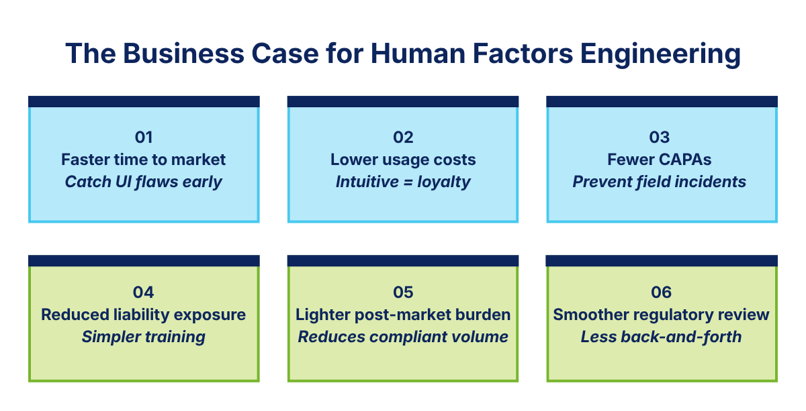
When integrated early and systematically, Human Factors Engineering aligned with IEC 62366-1 delivers concrete business value:
- Faster time-to-market: Catch user interface flaws during design, when they are cheap to fix, rather than after a 510(k) deficiency, or worse, a field action or recall.
- Lower usage costs: Error-resistant design and simpler user training reduce the customer service and support burden over the product’s life.
- Fewer Corrective and Preventive Actions (CAPAs): Proactive use-error and use-related risk prevents the costly corrective actions that follow field incidents.
- Reduced liability exposure: Documented HFE provides defensible evidence of due diligence against use-error-driven adverse events, and the product liability claims they generate.
- Lighter post-market burden: Robust HFE reduces complaint volume and adverse-event signals, easing post-market surveillance obligations under regimes such as the EU MDR.
- Smoother regulatory review: Complete, standard-compliant documentation reduces back-and-forth with reviewers and aligns directly with the regulator’s expectation of a usability engineering file/report.
The question isn’t whether to invest in HFE. It’s whether you’re doing it efficiently enough to gain the advantage.
The IEC 62366-1 Framework and Where Companies Get Stuck
IEC 62366-1 lays out a structured usability engineering process. At its core, it requires teams to work through a connected set of activities, including:
- Define the use specification: Who are your users? What are their tasks? Where and how will the device be used?
- Identify safety-related user interface characteristics: Which interface elements, if misunderstood, could lead to harm?
- Analyze hazards and hazardous situations: What could go wrong, and under what circumstances?
- Develop hazard-related use scenarios: Map realistic sequences of events, including reasonably foreseeable misuse.
- Plan and conduct evaluation: Use formative evaluation to find and fix problems during design, then summative evaluation to validate that critical tasks can be performed safely by representative users
The challenge is that these activities generate large volumes of interconnected data: use scenarios, risk linkages, task analyses (including Perception-Cognition-Action (PCA) breakdowns), severity ratings and the traceability between them. All of it must be captured and kept up to date in a usability engineering file. Managing that in spreadsheets or disconnected documents is where teams lose time, introduce traceability gaps, and expose themselves to regulatory scrutiny.
How Compass MED Transforms Usability Engineering
Compass MED was built specifically to bring structure, traceability, and efficiency to this process by replacing fragmented documentation with a centralized, compliant usability engineering data.
- Use Specification: Document the intended medical indications, patient populations, user profiles, and use environments in a structured format that is directly tied to downstream analyses.
- Preliminary Hazard Analysis & Use Scenario Analysis: Identify predictable misuse and map PCA steps to identify where perception or cognitive failures are most likely to lead to use errors.
- Product Risk Analysis: Link sequences of events to hazardous situations and harms, creating the traceable bridge between use error and risk.
- Use Error Analysis & Side-Effect Analysis: Map initiating events and risks associated with the correct use of the device to drive informed design decisions.
- Summative Evaluation Support: Identify critical tasks for final validation directly from your use error analysis to ensure your summative study is targeted and defensible.
Every output is export-ready, formatted for PDF or Word, and includes electronic signatures, so your usability engineering file is audit-ready at every stage.

Bridging Risk Management and Usability
Perhaps the most powerful aspect of Compass MED is how it unifies risk management and usability engineering — two disciplines that have traditionally operated in silos.
In Compass MED, traditional “failure modes” are reframed as “use errors.” This isn’t just semantic. It enables teams to perform root-cause analysis that connects human perception and cognitive behavior directly to technical reliability analyses by creating a more complete picture of how and why use errors occur, and whether they may ultimately lead to risks.
By using unified Risk Data Libraries, the same as used by other risk assessment tools, teams can build on a foundation of known hazards and harms, maintaining consistency across device families and reducing the time spent recreating analyses from scratch.
The result: a risk management process that accounts for how humans behave — not just how they’re supposed to behave.
Ready to Build Safer Devices, Faster?
Human Factors Engineering done right doesn’t slow your development down; rather, it accelerates it. With Compass MED, your team has the structure, traceability, and regulatory alignment to move from design to submission and beyond with confidence.